The Current
FRIDAY, OCTOBER 16, 2026 • TECHNOLOGY AND SCIENCE
An independent newspaper about what changed, what works and what deserves a closer look.
01 / MODELS AND AGENTS
Beam becomes something you can run
Reflection’s October 16 release turns an earlier announcement into downloadable weights and an inspectable coding harness.

The important change today is availability. Reflection announced Beam on October 5; on October 16 it released model weights under Apache 2.0. The public Hugging Face repository now contains the actual checkpoint shards. This is a concrete new option for teams that want to host, adapt or evaluate a capable text model themselves.
Beam is a mixture-of-experts model: each token uses only part of its 501-billion-parameter network. Reflection lists 23 billion active parameters and a one-million-token context window. Sparse computation reduces work per token; it does not remove the need to store the remaining experts. The BF16 repository is approximately one terabyte.
The companion Mirror CLI is equally interesting. Its public source and documentation describe resumable conversations, parallel worktrees and a Rust agent core behind a Python interface. Those are practical building blocks for experiments with long-running coding work, rather than another chat window.
There are important boundaries. Mirror is early beta. Its manual approvals do not sandbox commands, and rewinding a conversation does not undo file changes. Reflection’s reported 81.6% SWE-bench Verified and 80.1% Terminal Bench v2.1 results are vendor evaluations, not a guarantee on your repository.
Worth trying next: a small, fixed set of repository tasks, with the same tools and time budget as an incumbent. Count accepted fixes, recovery after interruption, total tokens and human review time. The useful result is a reproducible tradeoff, not a leaderboard victory.
READ THE SOURCES Release · Oct 16 / Weights and files / Model card / Mirror documentation
02 / CREATIVE TOOLS
The edit is becoming the medium
Krea 3’s October 15 open beta puts selective changes and quick iteration at the center of image generation.

The most useful image model may be the one that leaves your favorite parts alone. Krea 3 launched in open beta on October 15 with a focus on editing existing images: move a product into another scene, change a material, or combine visual references while preserving identity and detail.
Krea says most edits finish in under eight seconds at native 2K, with a listed price of $0.06 per 2K image and $0.03 at 1K. These are vendor claims and prices, not measurements from this publication. Its examples emphasize regional editing and product consistency, where small unintended changes can ruin an otherwise attractive result.
What is actually available
Krea’s own model page is live, and fal publishes a krea/v3/edit API schema. Open weights are not a confirmed release: the team’s launch discussion describes them as under consideration. A local deployment should not be planned around a future promise.
A useful reality check
The launch materials disagree about reference-image limits: the blog says six, the showcase says eight, and fal’s earlier landing page says four. Confirm the live endpoint’s schema before building a batch workflow. Promotional speed comparisons also use different samples and timings; the showcase explicitly labels one animation illustrative.
Practitioner feedback is more useful than a single beauty contest. In the Hacker News discussion, the designer posting as jjcm shared side-by-side UI examples and reported that a requested hex color leaked into visible text. That is an anecdote with inspectable examples, not a general benchmark, but it suggests an excellent test case.
Our take: evaluate preservation separately from beauty. Ask for one color change, then inspect the logo, typography, face and untouched background at full resolution. Repeat several edits from the same original and compare them with a chain of edits. A model that keeps the right constraints can be more valuable than one spectacular first frame.
READ THE SOURCES Launch · Oct 15 / Showcase and caveats / fal API schema / Practitioner examples
03 / ROBOTICS AND EMBODIED LEARNING
Touch can teach a robot’s eyes
Spark-0 asks whether tactile data can make robots better even when they navigate the world through vision alone.

Spark-0, submitted to arXiv on October 15, investigates an intriguing possibility: touch recorded during training can improve a robot that uses only vision at deployment.
The authors train with HumanTouch, 1,000 hours of human manipulation recorded with tactile gloves, alongside other video, robot and simulation data. Contact maps teach visual representations where interactions happen; a separate tactile pathway can inform the action model when touch sensors are available. Against a matched-data, matched-compute version that discards touch, reported vision-only success on the Ego Humanoid benchmark rises from 52.5% to 71.7%. On SparkArena’s real-robot track, using touch at deployment as well, success rises from 44% to 52%.
The less glamorous contribution is the measurement system. HumanTouch combines flexible gloves, finger and wrist tracking, and head- and wrist-mounted cameras. Its documentation emphasizes that fabric motion and sensor history can create false contact signals. Calibration uses posture and recent readings to distinguish those artifacts, while daily inspections exclude damaged gloves from the quality-qualified recordings.
Crucially, the documented outputs describe relative contact activity rather than calibrated physical force or object weight. An attractive contact heat map should therefore not automatically be read as a measurement of absolute mechanical load.
Availability needs careful wording. The training paper describes 1,000 hours, but the public Hugging Face card still labels its initial release as approximately 100 hours across ten tasks, with expansion planned. It directs readers to ModelScope for the governing license. A public repository exists; that is insufficient evidence that the entire training corpus or a deployable checkpoint is available.
The results are author-reported preprint findings, and the real-robot benchmark uses one dexterous embodiment. The useful hypothesis is narrower than general robotic dexterity: tactile supervision may improve representations before deployment. If reproduced across hardware, that could make human interaction recordings valuable beyond robots carrying the same sensors. For now, this is a promising experiment with a particularly instructive data pipeline, rather than evidence that contact-rich manipulation is solved.
READ THE SOURCES Spark-0 paper / Acquisition method / Public dataset
04 / GENOMICS AND SCIENTIFIC SOFTWARE
Reading both copies of the genome
FIRE helps reveal differences between inherited copies of the genome, opening more precise questions for the laboratory.

A Cell study highlighted by University of Utah Health on October 15 shows how machine learning can help connect disease-associated DNA variants to the regulatory switches controlling a gene.
The method, FIRE, analyzes individual long DNA molecules measured with Fiber-seq. Long reads help distinguish the chromosome inherited from each parent. A semi-supervised classifier then separates accessible stretches likely to function as regulatory elements from ordinary gaps between DNA-packaging structures. The published documentation identifies XGBoost and Mokapot as components and describes precision estimates for individual calls.
In one laboratory experiment, changing a celiac-disease-associated DNA letter altered the accessibility of a nearby regulatory switch. That suggests a functional mechanism, not a treatment. The researchers also identified tens of thousands of candidate regulatory regions missed by earlier approaches.
About 40% of the copy-specific regulatory differences described in the university’s account occurred without a genetic difference at that location. This is not 40% of all biology. The preprint examines stable, cell-lineage-associated chromatin differences, distinguishing regions with and without overlapping variants.
There is something practical to inspect today. FIRE’s public repository provides an MIT-licensed Snakemake workflow. A companion UCSC track hub exposes chromatin accessibility and regulatory-element calls across cell lines and tissues, including overlays comparing the two inherited copies. Researchers can examine the outputs before deciding whether to process their own sequencing data. This makes the work immediately useful for inspecting specific loci and planning carefully targeted follow-up laboratory experiments.
The timing matters: this is a journal-publication milestone for work with a preprint lineage dating to 2024, not a tool invented this week. The near-term value is better, more precise experimental prioritization. Clinical usefulness will require establishing which newly visible regulatory differences actually cause disease and which merely accompany it.
READ THE SOURCES Utah research report / Technical method / Code and license / Genome browser
05 / THE FIELD GUIDE
Four ways to make progress visible
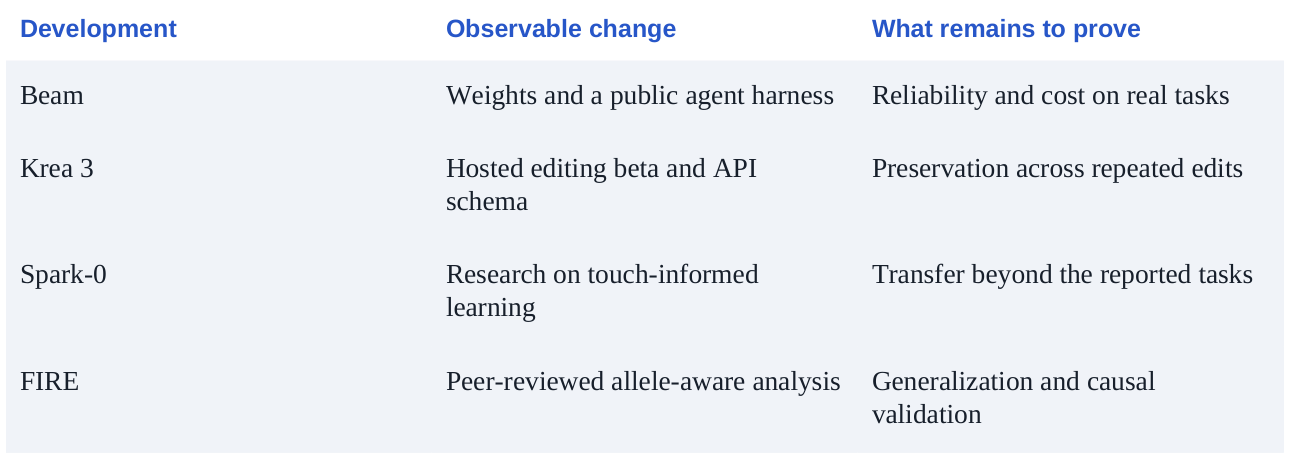
An original comparison and two short editorial essays, drawn from this issue’s reporting.
The best demo includes a mistake
Original essay
A perfect demo teaches you what a system can do once. A recoverable mistake teaches you how it might behave every day. The next generation of useful demonstrations should show the interrupted session, the rejected tool call, the wrong color and the evidence that changes an answer.
This is not a demand for pessimism. Recovery is a capability worth celebrating. A tool that notices a stale file, asks before overwriting it and resumes cleanly has done something impressive. It has respected the boundary between its own story and the state of the world.
For builders, the practical move is simple: add one deliberate disruption to each evaluation. Change a source. Cancel a command. Remove an input. Then inspect the resulting artifact, not just the explanation. A successful recovery belongs next to speed and accuracy in the release notes.
Let curiosity choose the sensor
Original essay
This issue moves from model weights to image edits, robot touch and the two copies of a genome. The common theme is observation. Each system becomes more useful when it can distinguish things that previously looked the same: a conversation from a filesystem, an intended edit from collateral change, an object’s appearance from its contact behavior.
That suggests a different starting point for invention. Before asking for a bigger model, ask what the current system cannot observe. Would a pixel difference, a force trace, a version identifier or a phased molecule make the question easier?
More information is not automatically better. Sensors cost money, annotations take time and new channels create new failure modes. But the right measurement can turn an ambiguous task into a tractable one. The most exciting engineering often begins by making a hidden difference visible.
ABOUT THIS EDITION
Reporting checked October 16, 2026. Research papers, release documentation and public practitioner examples were used to separate availability from claims. No hands-on paid testing was performed. Diagrams are original explanatory illustrations, not experimental data. Independent publication; no company endorsement implied.