THE CURRENT
SCIENCE / SOFTWARE / THE THINGS WE CAN EXAMINE
The proof is only the beginning
OpenAI releases extraordinary mathematical claims and the artifacts needed to examine them

Research release October 26
One of Monday’s most striking AI announcements was not a chatbot. OpenAI published mathematical artifacts supporting claims about wave behavior and the limits of computation, while convening external researchers to understand them. The announcement is remarkable; treating it as settled scientific understanding would be premature. [1]
One claim concerns local smoothing: roughly, extreme wave concentration cannot persist in the way a worst-case snapshot might suggest. OpenAI says its result applies in every dimension two and higher, with implications for the Kakeya and restriction conjectures. Natural-language arguments and Lean formalizations are public. [1, 2]
The computer-science claim challenges the Exponential Time Hypothesis, a foundation for many conditional arguments about computational difficulty. The repository describes a deterministic procedure for exactly counting satisfying assignments of fixed-width CNF Boolean formulas in subexponential time. Its scope note explicitly distinguishes the formalized bound from a sharper bound in the manuscript. Those are not interchangeable claims. [3]
Subexponential does not mean polynomial, and neither means fast enough to run usefully tomorrow. This is not an announcement that P equals NP or a release of a practical general-purpose solver. [3]
OpenAI describes the manuscripts as raw research material and is supporting independent examination. Its physics collaboration has not released the underlying AI artifacts. The public mathematical material can be inspected now; this edition has not built or independently checked the proofs. [1]
Inside this issue
02 When a fluent answer is a memory leak
A repaired inference incident exposes a boundary that model benchmarks do not test.
03 An analysis you can take apart
Lumen 1.4 makes intermediate work more visible and easier to revise.
04 Robots bridge the furnace gap
Materials discovery needs dependable physical handoffs, not only good suggestions.
05 The instrument and the evidence
A visual comparison and two short essays on inspectability and small-machine ingenuity.
[1] OpenAI research announcement October 26 [2] Local smoothing Formalization scope [3] Exponential Time Hypothesis Formalization scope
Independent publication. No affiliation with or endorsement by the organizations covered. Editorial cutoff October 27 at 14:15 UTC.
02 INFRASTRUCTURE / EXPLAINER
When a fluent answer is a memory leak
Cloudflare’s disclosure shows why inference correctness includes who owns the memory
Disclosed October 26 Repaired September 9
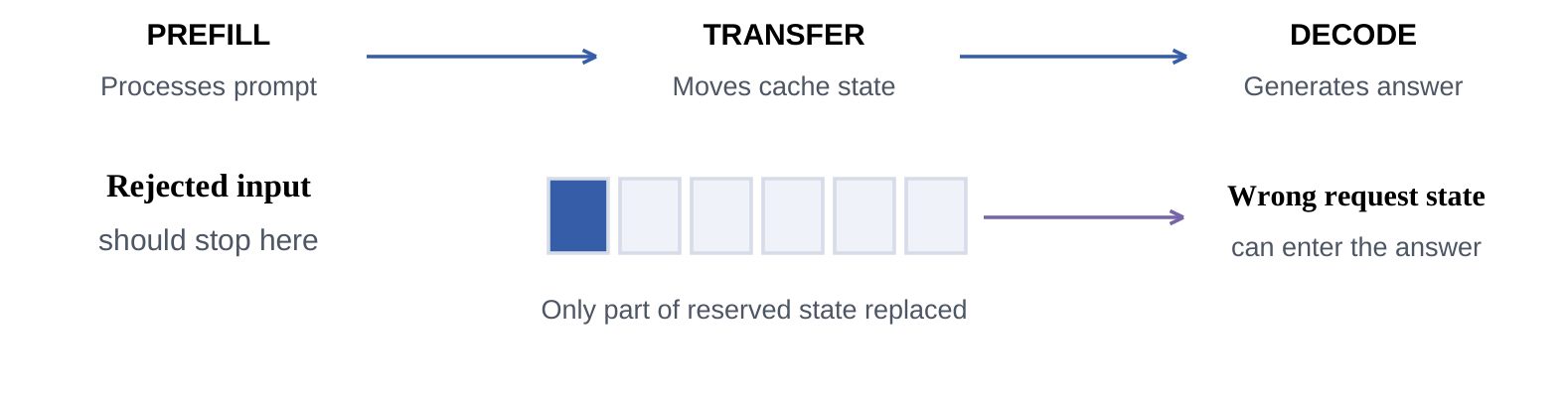
Cloudflare reports that 155 GLM-5.3 Workers AI responses included material from other customers between August 27 and September 9. Its deployment advertised more context than the prompt-processing cache could hold. A SGLang rejection-path bug then let oversized requests proceed into generation. This is a newly disclosed, previously repaired incident—not evidence of a new flaw in the model’s weights. [4]
The key-value cache stores intermediate attention state so generation does not repeatedly recompute the whole prompt. As Hugging Face’s explanation shows, each new token can reuse the keys and values of earlier tokens rather than calculating them again. That saves work while making stored state an essential input to the answer. [4a]
SGLang separates two workloads: computation-intensive prompt processing and memory-intensive token generation. Its documentation explains that combining them can let incoming prompts interrupt generation and create scheduling imbalance. Splitting the stages is therefore a performance strategy, not merely an arbitrary architectural complication. It also creates a handoff to reason about. [4b]
Capacity is not isolation
Cloudflare increased the cache pool and fixed admission handling. Its report also describes ongoing lifecycle hardening; the available SGLang v0.5.22 release is part of the upstream remediation sequence. Operators should distinguish shipped fixes from longer-term work on page ownership checks. [4, 5]
The useful mental model is an assembly line whose intermediate product is invisible to the user. The final sentence may look ordinary whether the handoff was correct or not. A responsiveness benchmark measures the line’s speed; a provenance check asks whether the right material moved through it. Neither measurement substitutes for the other.
Two ledgers for one service
A practical evaluation should keep two records. One captures latency and throughput under a stated workload. The other captures whether answers match controlled inputs and whether failures remain failures. Define the expected result before running either test. Otherwise, a system can receive credit for completing work that it should have refused.
That is an editorial recommendation, not a test performed for this edition. It also explains why changing the model alone is an incomplete response to a serving problem. Models supply the computation; the surrounding system decides which state that computation is allowed to use.
[4] Cloudflare incident report Disclosure October 26 [5] SGLang v0.5.22 Available release and changes [4a] Hugging Face How attention caching works [4b] SGLang documentation Why separate prefill and decode
03 OPEN SOURCE / AVAILABLE NOW
An analysis you can take apart
Lumen 1.4 puts more of the work between a question and a chart within reach
Released October 26
A polished chart can be an excellent hiding place for a bad assumption. HoloViz’s Lumen 1.4.0 is interesting because its improvements reach behind that chart: more useful table context, tool failures returned to the model, and scoped traces of model and tool activity. The release is published on GitHub and distributed on PyPI, not merely demonstrated in a video. [6, 8]
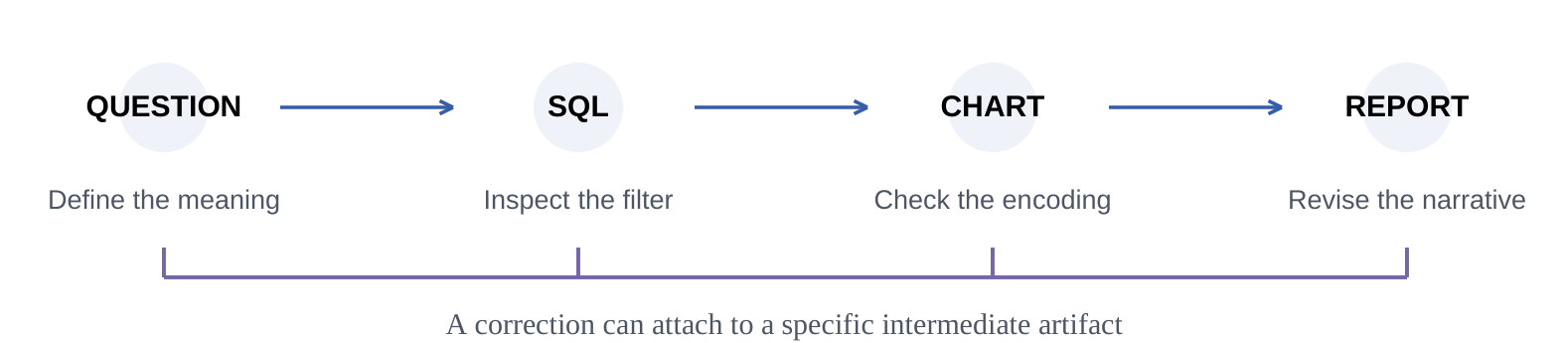
Lumen turns natural-language questions into plans, queries and visualizations. Its interface exposes the plan, SQL and chart specification so people can change the intermediate work. The project supports sources beyond ordinary tables, including scientific grids and geographic data. [7]
Version 1.4 adds compact, cache-friendly table context and a SQLAgent data-cleaning mode. Token accounting and estimated costs make the expense of an analysis more visible. Returning tool errors lets the model attempt a correction rather than simply ending at a failed operation. None of these mechanisms establishes that the repaired result is right. [6]
The artifact is the advantage
Imagine asking which month had the highest rainfall. A chart alone hides whether missing days became zeros, whether duplicate stations were counted twice, or whether totals and averages were confused. A visible query gives those questions somewhere concrete to land.
That is a useful change in the unit of work. Instead of accepting or rejecting an answer as a whole, an analyst can inspect a particular filter, transformation or visual encoding. The benefit is not that review disappears. It is that a correction can become a reusable part of the analysis rather than a note in a conversation.
Lumen can turn an exploration into a report with editable narrative and export it to formats including Word. Dashboards can also live as YAML specifications. Those outputs create a path from a one-off question to an artifact that can be revisited when the underlying data changes. [7]
Access is not the same as free inference
The new release supports already-authenticated command-line providers, including Claude Code, Codex and GitHub Copilot, and adds Kilo’s keyless tier. A missing API-key prompt does not imply unlimited free usage. Provider terms and routing still matter; the release also raises its Panel and Bokeh requirements. [6]
A sensible first evaluation would use a public dataset with a known answer, one ambiguous question and one deliberately awkward schema. Compare the resulting query, chart and narrative—not just whether the app completes. This edition verified release records and documentation, but did not install or benchmark the software.
[6] HoloViz Lumen 1.4.0 Release notes October 26 [7] Lumen project documentation Workflow and editable outputs [8] PyPI distribution record Lumen 1.4.0
04 LAB AUTOMATION / MATERIALS
Robots bridge the furnace gap
A materials laboratory connects the physical steps that separate a suggestion from a specimen
Announcement October 26
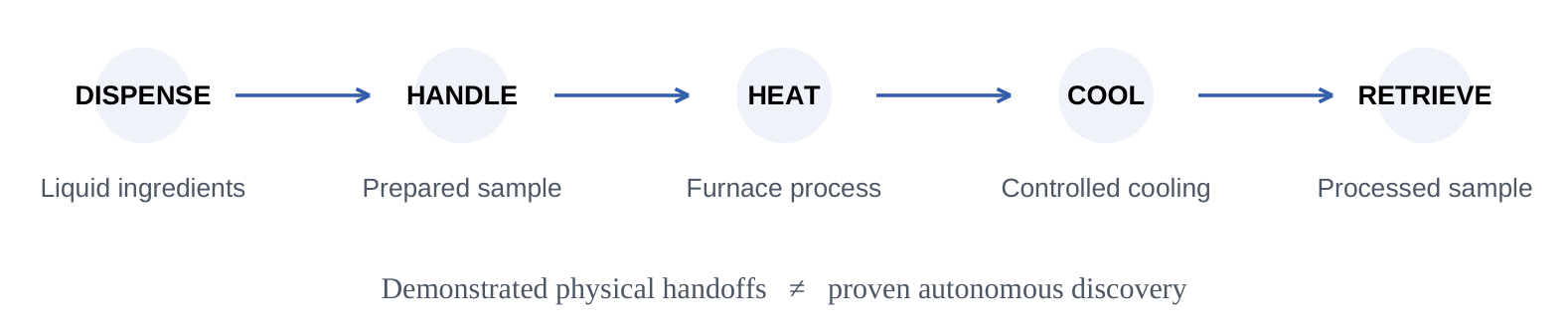
The awkward part of a robotic laboratory may be the journey to the furnace. Nottingham researchers have joined liquid dispensing, sample handling, high-temperature processing, controlled cooling and retrieval into an automated workflow. Two arms, a custom dispensing tool and coordinating software connect tasks that otherwise require separate handling. [9]
The announcement reports liquid-dispensing calibration and automated preparation through sample recovery, but no numerical throughput or uptime benchmark. The cited robotic-system paper is a ChemRxiv working paper. This is a research demonstration, not a commercial appliance. [9]
The intended application is thermal-barrier materials: ceramics that slow heat reaching components in demanding environments. For a discovery program, every composition chosen on a screen must eventually become something measurable. Automating the handoffs could reduce the friction of running repeated experiments. Whether it does so reliably over long campaigns needs evidence.
An older study supplies useful context
A companion active-learning study was first posted November 26, 2025. It combines Bayesian optimization with a random-forest predictor to choose rare-earth oxide compositions. Four candidates were synthesized across two rounds. These numerical results are background to this week’s announcement, not discoveries made yesterday. [10]
Two first-round candidates formed the desired single-phase pyrochlore structure. Their measured thermal conductivities were 2.03 and 1.90 W/mK, versus a prediction of 2.009 W/mK for each. The second round produced dual-phase materials instead. The authors identify crystal-phase formation as something the learning framework must account for. [10]
The second objective is often the hard one
This is a good example of why an attractive target number is not the whole problem. Selecting for low heat conduction is not identical to selecting a material with the desired structure. A search system can become better at the property it is asked to predict while still missing a constraint that matters to the experiment.
The pragmatic opportunity is to make the physical record richer: what was mixed, how it was processed, what structure formed, and how the measurement was obtained. A failed candidate is more useful when its preparation history is dependable. That is an operating principle, not a reported performance result.
The evidence does not establish service-ready coatings or a fully closed discovery loop joining this apparatus to the learning algorithm. It shows progress on an essential part of automation: connecting physical operations.
[9] University of Nottingham announcement via Phys.org October 26 [10] Authors’ active-learning preprint November 26 2025
05 PERSPECTIVE / ORIGINAL ESSAYS
The instrument and the evidence
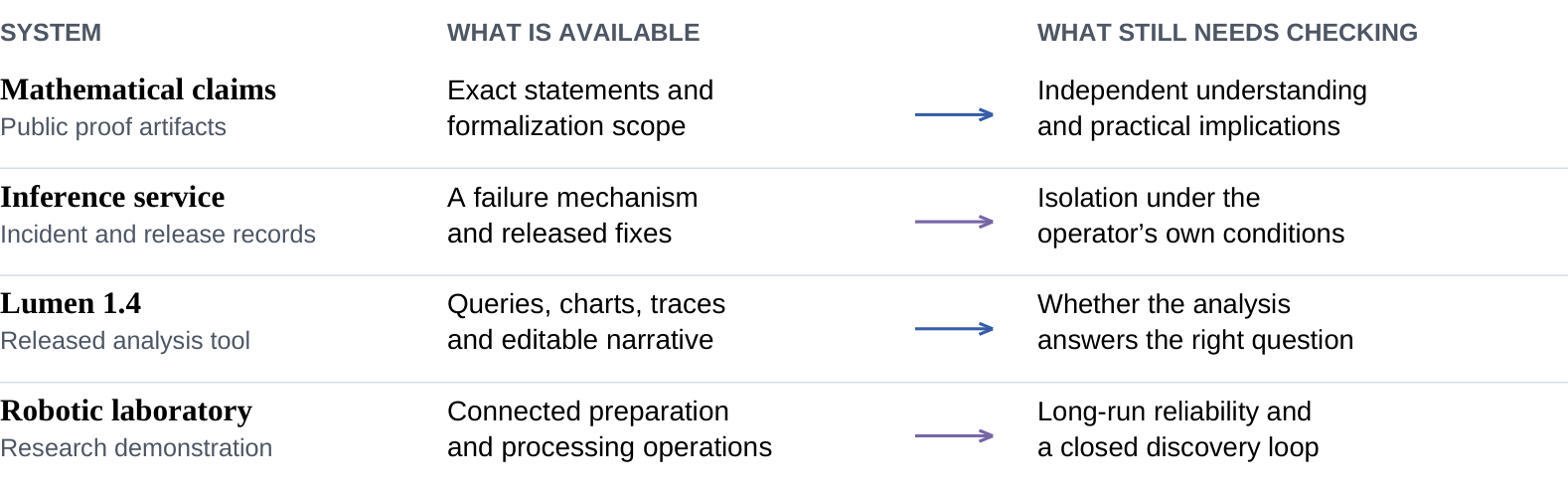
Four different systems leave different things for us to inspect
An interface for disagreement
The best reviewable artifact is not necessarily the one with the most explanation. It is the one that lets someone disagree precisely.
A sentence saying that an analysis was checked is weak leverage. A query, a formal statement or a specimen’s processing record gives another person a place to point. They can say: this filter excludes the wrong rows; this theorem is narrower than the headline; this measurement belongs to a different batch.
That precision changes collaboration. A disagreement becomes a change request instead of a contest of confidence. It can be tested, preserved and revisited. The system gains memory of the correction rather than simply generating another plausible response.
There is a design challenge here for every AI-assisted tool: make intermediate work understandable without forcing everyone to read every intermediate step. Good defaults should expose the decisions most likely to change the conclusion, while leaving the deeper record available.
The aim is not permanent manual supervision. It is to make useful scrutiny cheap enough that evidence can improve the workflow. An interface for disagreement may be one of the most practical forms of automation.
The pleasure of a small machine
An engineering writeup circulating on Hacker News offers a welcome change of scale. Its author implements an accelerated FAST corner detector on an ESP32-S3 microcontroller, using 128-bit SIMD instructions to work on multiple pixels at once. The author reports about six milliseconds for a 320 by 240 frame, with source code linked. [11]
The reported throughput rises from 5.1 to 11.2 megapixels per second: about 2.2 times the original throughput, or a 120 percent increase. Those are author measurements, not an independent benchmark. The page has no visible publication date, so this is a reading discovery, not a claimed October 27 launch. [11]
The delightful part is the constraint. Misaligned reads and signed-byte comparisons force the programmer to understand the machine closely. A small bit-level transformation makes pixel comparisons behave as intended. [11]
It is tempting to treat progress as buying a bigger engine. Sometimes the interesting advance comes from discovering what the engine already has. A cheap controller doing one narrow job well is not a rival to a frontier model. It is a reminder that intelligence in an engineered system also lives in the representation, the layout and the choice of task.
[11] SIMD accelerated computer vision Author’s implementation and measurements
Source notes: primary releases, author repositories and research records underpin the reporting. The robotic announcement is university-authored coverage; its linked working paper was not independently accessible. No software or proof builds were run for this edition.