THE CURRENT
4 NOVEMBER 2026 / INDEPENDENT READING EDITION
Hy4 learns to look and act
Tencent’s new model adds visual understanding and computer use. Hosted access has arrived; downloadable weights are still a promise.

Tencent released Hy4 on November 4, adding visual understanding to a family previously centered on text. The company describes stronger instruction following, long-context work and extended agent tasks, including operating software. It says model weights and system cards will follow in the coming days. That makes this a hosted launch, not yet a new downloadable release. [1]
OpenRouter’s listing confirms text and image inputs, text output, tool calling and a 1,048,576-token context window. Those are useful interface facts. They do not establish that the system reliably completes a million-token assignment. [2]
A screen becomes an input
For a computer-using assistant, a screenshot supplies clues that a text-only tool may miss: a chart’s shape, an unfamiliar dialog, a button’s position. A controller can pass that image to the model, execute its proposed action and return the changed screen. This diagram explains the general architecture; it is not a map of Tencent’s implementation.
Analysis The check after the click
A convincing demonstration can hide a fragile step. Suppose an assistant edits a spreadsheet, clicks Save and announces completion. The important test is whether the saved file contains the intended values. Screen interpretation helps reach the button; verification establishes whether the job actually finished.
That distinction suggests a practical trial: use a disposable copy of a familiar document, define the desired final state and inspect the result independently. Count completed tasks and recoverable errors, including time spent supervising. A long context window and a low token price cannot supply that measurement.
What can be tried today
The new model is listed on OpenRouter, while Tencent names its own apps and cloud services as access routes. Readers who need self-hosting should watch for the actual weights, license and system card rather than assume the August preview’s release terms carry forward. [1–3]
The useful next evidence is ordinary work done repeatedly: successful outcomes, failure recovery and the amount of human checking still required.
[1] Tencent announcement · 4 Nov 2026
[2] OpenRouter Hy4 model listing
[3] Tencent Hy4 Preview release · 28 Aug 2026
02 / SCHOLARSHIP AND AI
The library gets an AI doorway
Three university presses are building a shared route from licensed scholarship into research assistants. The harder question comes after retrieval.

Johns Hopkins University Press announced on November 3 that it is joining Cambridge University Press and Princeton University Press as founding publishers of Meridian. Convened by infrastructure company Cashmere, the initiative proposes a shared gateway through which AI tools can reach authorized scholarly material with attribution and citations. [4]
The joint announcement identifies that gateway as using Model Context Protocol, or MCP, a way for AI applications to connect to outside tools and information. Publishers would integrate once rather than separately with each assistant. Participation is optional and non-exclusive, and publishers can withdraw titles. [5]
The plan includes library usage reporting and links to the publisher’s version of record. Content accessed through the service is not to be used for training or fine-tuning models. Catalog onboarding is scheduled for November, with a closed pilot for selected institutions later this fall. This is an announced access program, not a public service already available to every reader. [4, 5]
Analysis Access is the first test
Imagine asking an assistant why two historians disagree. The useful response needs more than two citations. It should represent each argument fairly, distinguish their evidence and make the relevant passages easy to inspect. A permissioned connection can make the books reachable; it cannot by itself make the comparison sound.
A citation should do work
A source link is most valuable when the reader can use it to challenge the answer. Did the cited author actually make that claim? Was the sentence qualified elsewhere? Is a summary treating a disputed interpretation as settled? These questions survive even when every document has been properly licensed.
Meridian’s design therefore invites a revealing pilot. Give researchers questions whose answers depend on a footnote, a disagreement or a passage outside the obvious chapter. Check whether the assistant retrieves the right material and whether its answer preserves the distinction. Then ask users to follow the citation. A correct answer with an unusable route back to the source still makes verification expensive.
The test for libraries
Usage counts can show that a collection was consulted. They cannot alone show that the consultation improved understanding. A useful evaluation would pair access statistics with audits of citation accuracy, coverage and reader comprehension. It should also examine what happens when the relevant book is absent.
For now, libraries and publishers can study the proposal and pilot terms. Readers should watch for participating collections, supported assistants and published results. The strongest promise here is a more inspectable research path. Whether it produces better research remains an empirical question.
[4] Johns Hopkins University Press announcement · 3 Nov 2026
[5] Founding publishers’ joint release · 3 Nov 2026
03 / MACHINE LEARNING
An AI that chooses rather than chats
Sarvam Prism returns probabilities over a fixed set of answers. That narrower job makes its confidence, and its mistakes, easier to examine.

Sarvam released Prism on November 3 as a decision model built on its 105-billion-parameter base. Give it context, a question and possible answers, and it returns probabilities rather than composing a reply. Its open model card lists an Apache 2.0 license and an inference path that scores the options in a single forward pass. [6,7]
That changes the interface. A support system can ask which queue should receive a ticket, with billing, delivery and technical support as the allowed answers. The model cannot invent a fourth queue in flowing prose. It can still choose the wrong one, and a badly designed option list can leave it without the right answer.
Fast has a hardware footnote
The model card reports a 44-millisecond median and a 420-millisecond 95th-percentile response on one NVIDIA B200, across 1,000 requests sent one at a time after loading. It asks for about 120 GB of free GPU memory and roughly 106 GB of disk. Custom FP8 weights require the supplied inference code rather than a general-purpose serving path. [7]
These are developer measurements, not a guarantee of application latency. A production system adds data preparation, queuing, network trips and any review step. The tail of the response-time distribution matters when a user or another system is waiting.
Analysis Confidence needs a local exam
Sarvam reports strong calibration in its evaluations. Calibration asks whether stated probabilities match observed frequencies: among comparable predictions given 90 percent confidence, roughly one in ten should be wrong if that confidence is accurate. Good calibration is useful, but it must be checked on the actual work a model receives. [6]
Consider a fictional routing test. Of 100 tickets labeled billing with 90 percent confidence, 25 turn out to belong elsewhere. The problem is not that every prediction failed. It is that the confidence invited more trust than this workload justified. A threshold copied from another benchmark would not repair that mismatch.
An evaluation should preserve a held-out set of real cases, including unusual and ambiguous ones. Measure both errors and how much work is sent to review. A system that avoids mistakes by referring everything has not automated much; one that never refers anything may simply be concealing uncertainty.
What is usable
Prism’s weights and code are public, and Sarvam also offers a hosted API. It is a concrete tool for bounded classification experiments. Start with a reversible task and include an appropriate escape route when none of the supplied options fits. Open weights make inspection and adaptation possible; they do not certify a decision process. [7]
[6] Sarvam Prism release and evaluation · 3 Nov 2026
[7] Sarvam Prism model card and inference requirements
04 / ROBOTICS
The robot that is easier to repair
Stretch Gen 2 targets the unglamorous causes of lost warehouse hours. Its most interesting upgrade may be the time a technician saves.

Boston Dynamics unveiled Stretch Gen 2 on November 3. The trailer-unloading robot’s redesign draws on more than 100,000 operating hours, according to the company. Its emphasis is durability and serviceability rather than a new body shape or a broader claim to general intelligence. [8]
The company says it removed 81 percent of the internal cabling, added tougher connectors and introduced continuous-rotation joints that avoid mechanical hard stops. A swerve-drive replacement is said to take about an hour instead of a full day. Modular parts and onboard diagnostics are intended to make more routine maintenance possible on site. [8]
Boston Dynamics advertises up to 1,000 cases per hour, while explicitly warning that box weight and stacking conditions strongly affect the rate. It describes battery life of two shifts. These remain vendor claims, not an independently measured improvement in a customer’s full-shift output. [8]
Analysis The shift is the unit
A robot can be fast whenever it moves and still disappoint over a working day. Waiting for service, clearing a jam or preparing the next trailer consumes hours that a peak picking rate excludes. That is why maintainability belongs in the performance discussion, not merely in a warranty appendix.
An imaginary warehouse test
Suppose a machine can unload 600 cases per running hour. If it spends six hours moving boxes during an eight-hour shift, it completes 3,600 cases. Recovering one lost hour at the same running speed raises that total to 4,200, a gain of roughly 17 percent. These are invented numbers, chosen only to show the arithmetic.
The example explains why a less dramatic repair can rival a faster motion planner. It also shows why repair time alone is insufficient: the failed component may be rare, replacement parts may not be stocked, or diagnosis may take longer than the swap. A good service result includes the whole interruption.
What buyers should ask to see
A useful trial would track cases per scheduled shift, minutes of unplanned stoppage, the reasons for each stop and the labor required to recover. It should use representative trailers, including awkward stacks, rather than only tidy demonstrations. Installation, safety procedures and maintenance staffing belong in the same assessment.
The new design gives operators specific things to examine with the vendor. The announcement does not establish delivery dates for every customer, an installed price or independent uptime results. Watch for evidence that the simpler hardware changes the daily operation, not just the specification sheet.
[8] Boston Dynamics Stretch Gen 2 announcement · 3 Nov 2026
05 / THE VISUAL COMPARISON
Four different meanings of ready
A hosted model, public weights, a proposed gateway and a physical robot are available in different ways. Their next useful tests are different too.
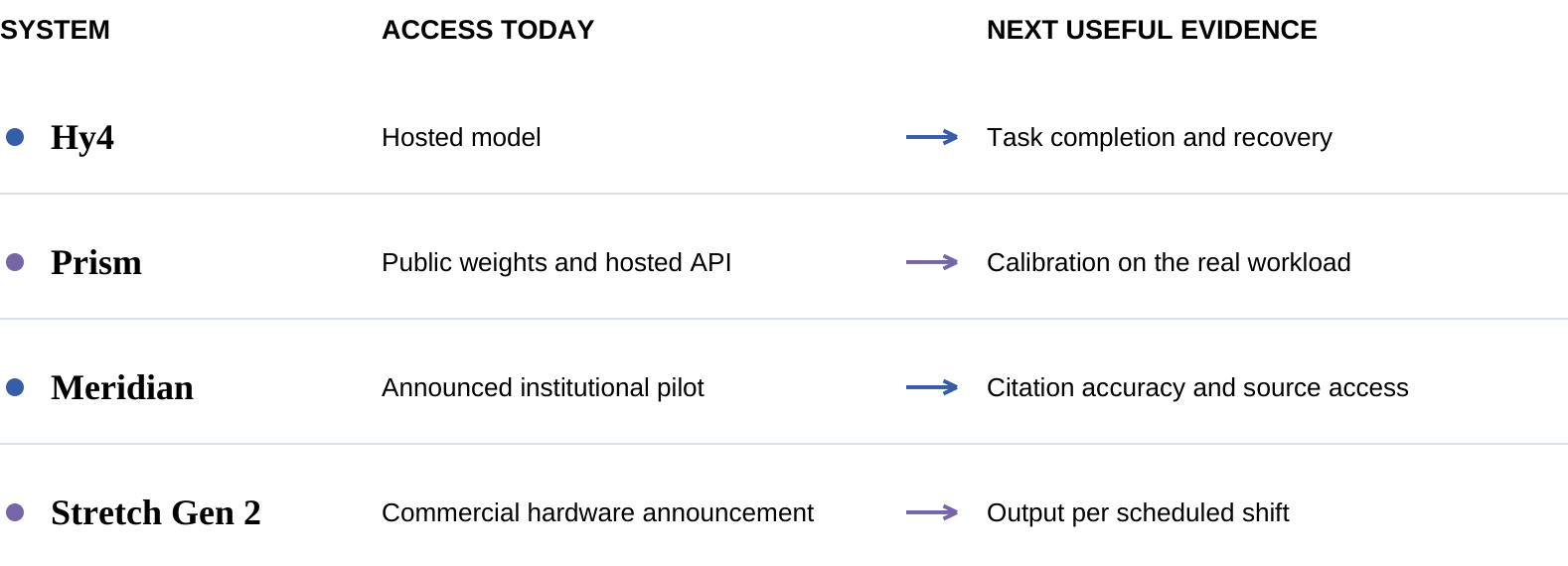
A launch is a starting condition
Hy4 can be tried through hosted services. Prism can be downloaded, subject to substantial hardware requirements. Meridian has announced a pilot path. Stretch Gen 2 is a commercial hardware announcement. Putting all four under a single label such as “released” would erase information a reader needs.
Availability is also separate from suitability. An API can be reachable while a task remains unreliable. Downloadable weights may be usable only on equipment a team does not own. A pilot may establish access before it establishes better answers. A robot’s headline rate may leave the installed system’s economics unresolved.
Match the evidence to the question
The most useful next question is usually narrower than “Does it work?” For Hy4, ask whether it completes a defined task and detects a failed step. For Prism, ask whether its confidence holds on new cases. For Meridian, follow the citation. For Stretch, count output across the entire shift.
What a careful comparison preserves
Keep the measurement’s denominator. Per running hour differs from per scheduled hour. Median latency differs from the slowest requests. Citation coverage differs from citation correctness. A task success rate differs from a favorable impression of a demonstration.
Keep the conditions, too. Hardware, data selection, human assistance and preparation can explain as much as the product name. A result becomes more portable when another person can understand what was held constant and what changed.
None of this requires waiting for perfect evidence before experimenting. It requires making the experiment answer a specific question. Reversible, limited trials are often enough to discover whether a promising system deserves a larger commitment.
Reading the source desk
The linked announcements and model card document what their publishers say. Analysis in this issue proposes tests and interpretations; it does not turn those announcements into independent validation. The two essays that follow are original editorial reflections.
06 / TWO SHORT ESSAYS
The options and the interruption
Original reflections on two design decisions that rarely appear in a launch headline.

The answer that was not on the list
A fixed menu looks like a modest interface choice. It is also a theory of the world. When a service offers billing, delivery and technical support, it has decided which kinds of trouble count as recognizable trouble.
That is useful until a customer arrives with a problem that crosses the categories. A package was delivered to the wrong person, the replacement triggered a second charge, and the account cannot be opened. Selecting the nearest label makes the record tidy. It may send the person on another trip through the organization.
An “other” option helps only if something happens next. If it drops the case into an unmonitored queue, the interface has acknowledged uncertainty without taking responsibility for it. The design problem includes the handoff: who sees the case, what context arrives and whether the original person must explain everything again.
The same is true of a model’s confidence score. A number can expose hesitation, but someone still has to decide what the hesitation changes. Perhaps the system asks one question. Perhaps it pauses a reversible action. Perhaps a human takes over with the evidence already assembled.
A good menu does more than constrain answers. It makes the edges visible and gives people a useful way across them. The smallest category on the screen may carry the largest design obligation.
A demonstration of getting unstuck
Most demonstrations end at the moment of success. The file opens, the gripper places the box, the answer appears. It is an understandable place to stop filming. The audience has seen the thing it came to see.
A more revealing demonstration might begin there and introduce one ordinary interruption. Disconnect a harmless test service. Offer an unreadable label. Move a button. Ask for a source that is not in the collection. Then watch how the system describes its situation.
Does it recognize that something went wrong? Can it distinguish a failed action from an action whose outcome is merely unknown? Does it preserve enough context for the next person to help? Can it return to work without repeating a consequential step?
These questions are less cinematic than an uninterrupted run, but they are close to daily ownership. A user does not buy the successful minute in isolation. The user inherits everything that happens before the next successful minute.
This is not an argument for making products look bad. It is an invitation to make recovery legible. Show the interruption, the diagnosis and the return. A system that handles a modest problem clearly gives the audience something sturdier than a flawless performance: a reason to understand what owning it would involve.